
Why Does My Cat Follow Me Everywhere?
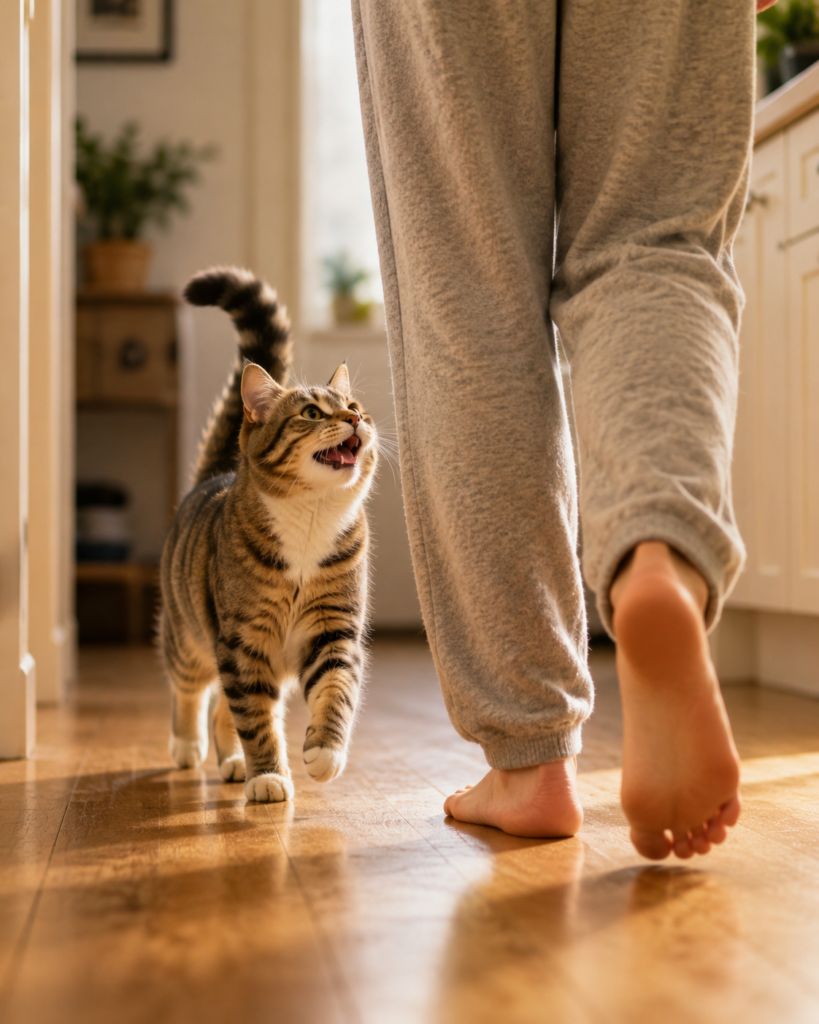
If your cat appears every time you move rooms, supervises bathroom visits and settles wherever you are working, you are not necessarily living with an unusually needy cat. Following can come from attachment, routine, curiosity, learned rewards and a desire to keep track of what is happening.
You are part of your cat’s safe territory
Cats build routines around places, resources and familiar individuals. A trusted person can become part of the map of what feels predictable and safe, so following you may simply be a way of remaining near a familiar anchor.
Your movements predict interesting things
People open cupboards, prepare food, operate taps, move toys and provide access to rooms. Cats are excellent at learning patterns, and following can be a practical strategy for not missing the next interesting event.
Some cats are naturally more social
Individual temperament matters. Some cats prefer to share space without touching; others actively seek proximity, conversation and lap time. Breed, early socialisation and life experience can influence this, but individual differences are more important than stereotypes.
Routine can turn following into a habit
If a cat receives a pat, treat or play session after following you, the behaviour can be reinforced without anyone consciously training it. That is not a problem unless the cat becomes distressed when separated.
A sudden increase can be meaningful
If an independent cat abruptly becomes unusually clingy, look for other changes in appetite, drinking, toileting, mobility, sleep or vocalisation. Behaviour change can be an early sign that something feels different physically or environmentally.
Give attention without making independence scary
Offer predictable play, resting spots near the areas you use, and periods where the cat can choose quiet time. The goal is not to stop a social cat from following you; it is to make sure closeness is a choice rather than the only way the cat can feel secure.
Frequently asked questions
Is it a sign my cat loves me?
It can be consistent with trust and social attachment, but no single behaviour proves an emotion by itself. Look at the overall pattern: relaxed body language, seeking proximity, slow blinking, play and comfortable sleep near you.
Should I discourage my cat from following me?
Usually no. If the behaviour is harmless, there is little reason to stop it. Focus instead on providing enrichment and comfortable independent resting places.
When should I speak to a vet?
If following behaviour changes suddenly or arrives with appetite, drinking, toileting, weight, mobility or other physical changes, veterinary advice is appropriate.